
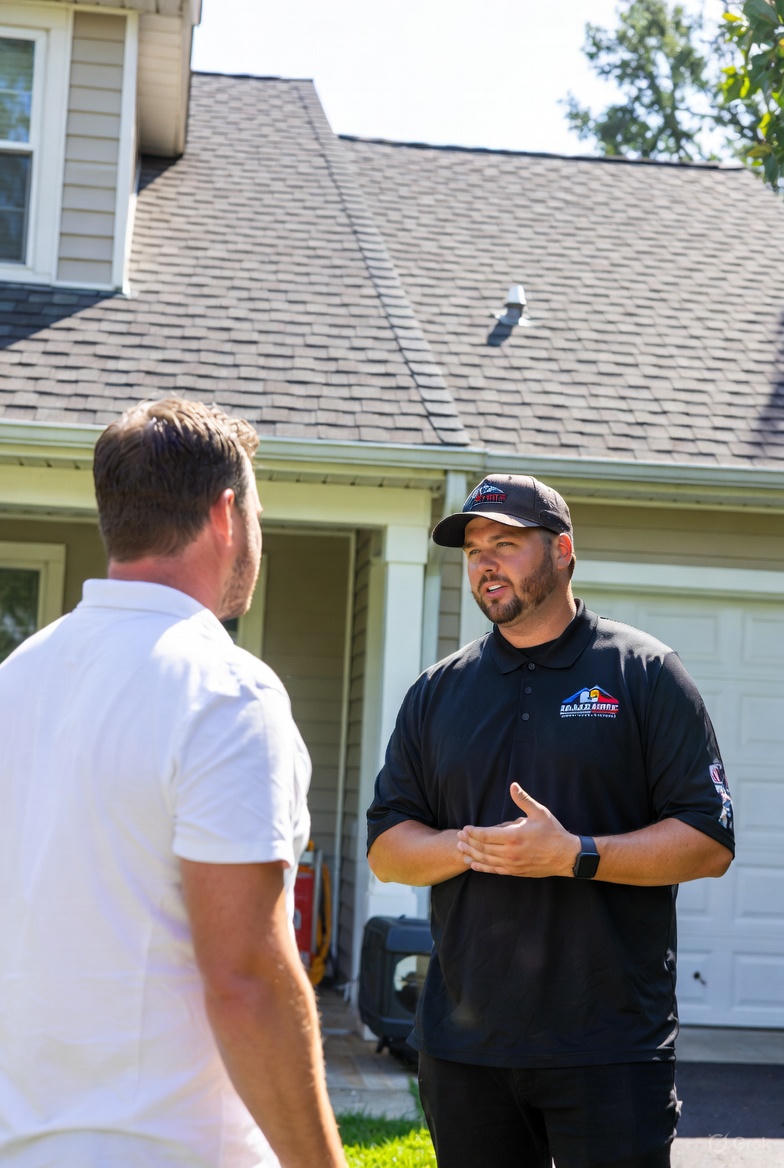
When it’s time for a major exterior remodel, the list of potential contractors can be overwhelming. You might have bids from huge national franchises, recommendations from neighbors, and confusing online listings, perhaps even one as vague as GME remodeling. Faced with this, many homeowners default to the biggest name or the cheapest price. This is a critical mistake. For a project as vital as your home’s exterior, the best choice is almost always the one closest to home: the local roofer who has built a business on community trust and evolved into a full-service exterior expert.
The “Big Box” vs. “The Local Pro”: Why Your Choice Matters More Than You Think
An exterior remodel is not a simple transaction. It’s a complex, multi-layered construction project that determines your home’s safety, energy efficiency, and value for decades to come.
A national chain or an out-of-town contractor often sees your home as just another job number on a spreadsheet. They are focused on volume, standardized processes, and shareholder returns. Their crews are often subcontracted, flying in from out of state and leaving as soon as the last piece of trim is up.
A local contractor, by contrast, operates on a foundation of reputation. Their name is on their truck at the local grocery store. Their kids might go to school with your kids. They can’t afford to do a bad job because they have nowhere to hide. This fundamental difference in accountability is the single most important reason to hire locally.
What is a “Local Roofer” (And Why Do They Handle Siding and Gutters?)
You might be thinking, “I need my siding and windows replaced. Why would I call a roofer?” The answer lies in how a house is built. The best exterior contractors often start as roofing specialists.
The Natural Evolution: From Roofer to Full-Service Exterior Contractor
A roofer’s job doesn’t end at the shingles. To install a roof correctly, they must be masters of the systems connected to it.
- They learn that a roof fails if the gutters are clogged, so they start offering gutter services.
- They see that gutters are attached to the fascia and soffit boards, and if that wood is rotted, the gutters will fail. So, they become experts at replacing and capping trim.
- They realize that the siding is the next line of defense and that the flashing where the roof meets the wall is a critical point of failure. It’s a natural step to begin installing and repairing siding.
- From there, windows and doors are the next logical service, as they are another major part of the home’s “envelope” that requires expert flashing and sealing.
This evolution is a sign of a healthy, knowledgeable business. They didn’t just add services to make more money; they added services because they understood they are all part of one interconnected system.
The Building Envelope: A System Only a Local Expert Truly Understands
Your home’s exterior—the roof, siding, windows, and foundation—is called the “building envelope.” Its one and only job is to protect the inside of your home from the outside elements.
A failure in one part of this system creates a cascade of problems. A local contractor who has seen hundreds of homes in your area understands this. They don’t just see a “roofing job” or a “siding job.” They see a complete system and can diagnose the root cause of a problem, not just the symptom.
Reason 1: Unmatched Local Accountability and Reputation
This is the most powerful argument for hiring a local company. Their reputation is their most valuable asset.
They Live Where You Live
A local roofer has a permanent, physical office or workshop in your community. They are invested. They pay local taxes, support local suppliers, and build a customer base of their neighbors. If you have a problem, you know exactly where to find them. They can’t just disconnect their phone and move to the next state.
The Dangers of “Storm Chasers” and National Chains
After a major hailstorm or wind event, your neighborhood will be flooded with “storm chasers.” These are out-of-town companies that follow bad weather, knock on doors, and offer “too good to be true” deals. They perform fast, substandard work using the cheapest materials and are gone before the first leak appears, leaving you with a voided warranty and a massive repair bill.
National chains present a different problem. While more stable, they are often impersonal. The “local” representative is just a salesperson. The installation crew may be a subcontracted team from hundreds of miles away. When a problem arises, you are directed to a national call center, not a person you’ve met.
Reason 2: Deep Knowledge of Local Codes and Climate
This is a practical, dollars-and-cents advantage. Every single municipality has its own unique, and often finicky, set of building codes, permit requirements, and inspection processes.
Navigating Your Municipality’s Red Tape
A large, non-local company may understand the general building code, but they don’t know the specific amendments for your town. They don’t know that your building inspector is a stickler for a particular type of flashing or that your county requires a special permit for dumpsters placed on the street.
A local contractor deals with the same building inspectors every week. They have a professional relationship and know exactly what is required to pass inspection the first time, saving you time, money, and stress.
Building for Your Specific Weather (Heat, Ice, and Wind)
A contractor from a dry climate has no real-world experience with preventing ice dams in the North. A roofer from a landlocked state may not understand the specific materials and nailing patterns required to withstand coastal, salt-filled air.
A local contractor has built their entire business around solving your area’s specific climate challenges.
- They know the right way to install an ice and water shield for your region’s snow-load.
- They know which shingle brands have the best wind-uplift rating for your local storm patterns.
- They understand the proper ventilation balance needed to fight your area’s specific humidity levels.
This local-climate expertise is something a national, one-size-fits-all training manual can never provide.
Reason 3: A Single Point of Contact for Your Entire Project
Hiring a full-service local roofer for your entire exterior remodel simplifies the entire process and eliminates the number one cause of project failure: poor coordination.
Avoiding the “Blame Game” Between Contractors
Imagine you hire three separate companies: a roofer, a siding installer, and a gutter guy. Six months after the job is “done,” you get a leak.
- The roofer says the siding contractor’s flashing is wrong.
- The siding contractor says the roofer cut the step flashing too short.
- The gutter guy says the overflow is caused by the roofer’s improper drip edge.
You are now trapped in a nightmare, trying to mediate a dispute between three parties who all insist it’s not their fault. When you hire one full-service exterior contractor, there is no blame game. There is one phone call and one point of accountability. It’s their job, and they have to fix it.
Coordinated Design and Seamless Installation
A single project manager ensures a cohesive vision. They will make sure the shingle color you chose perfectly complements the siding color. They’ll ensure the new windows are ordered in the correct “jamb” depth to align with your new, thicker insulated siding. This streamlined process prevents costly ordering mistakes and ensures the final product looks intentional and professionally designed.
Reason 4: Faster Service and Real Warranty Support
Your relationship with a contractor shouldn’t end when you write the final check. A good exterior system comes with two warranties: a manufacturer’s warranty on the materials and a contractor’s warranty on the labor. The labor warranty is often the more important one, as most failures are due to installation error.
What Happens When You Need a Repair?
Let’s say a freak windstorm blows one shingle off your new roof.
- The National Chain: You call a 1-800 number, get put in a queue, and are told a service technician “will be in your area in 4-6 weeks.”
- The Storm Chaser: Their phone number is disconnected.
- The Local Contractor: You call their office. They know who you are and where you live. They can often dispatch a crew that same day or the next to perform a 15-minute repair, preventing a small issue from becoming a major leak.
This on-the-ground presence and rapid service are invaluable for long-term peace of mind.
Reason 5: Supporting the Local Economy
When you hire a local contractor, your investment stays in your community. That money pays the salaries of local employees, who then spend their money at other local businesses. It supports local suppliers, print shops, and accountants. It’s a “virtuous cycle” that strengthens your community in a way that hiring a national conglomerate simply cannot.
What to Look For in a Top-Tier Local Contractor
Being “local” is the first step, but it’s not the only one. You must find a professional local contractor. Here are the non-negotiables to vet any company.
Proof of License and Full Insurance (The Non-Negotiables)
This is the first question you should ask.
- License: Are they licensed by your state and/or city to perform the work? This is your first line of defense.
- General Liability Insurance: This protects your property. If they drop a ladder through your window, this policy pays for it.
- Worker’s Compensation Insurance: This protects you from their employees. If a worker gets injured on your property and the contractor doesn’t have this, you could be held liable. Ask for a certificate of insurance to be sent directly from their insurance agent—this proves the policy is active.
A Permanent Physical Address (Not a P.O. Box)
A legitimate business has a real office or workshop you can visit. This proves they are a stable, permanent fixture in the community, not a “fly-by-night” operator working out of a truck.
Manufacturer Certifications (The Mark of an Expert)
This is how you separate the best from the rest. Top manufacturers (like GAF, CertainTeed, and James Hardie) have elite certification programs. These are not “pay-to-play.” Contractors must prove they are fully insured, licensed, have a proven reputation, and have passed factory training on the exact installation methods.
Looking for designations like GAF Master Elite Contractor or James Hardie Preferred Contractor is a sure-fire way to find a local company that has been vetted by the industry’s biggest names.
Conclusion
When you embark on an exterior remodel, you’re not just buying materials; you’re buying decades of security. The peace of mind that comes from knowing your contractor is just down the road, that they understand your local climate, and that their reputation is on the line with every job, is invaluable. A national chain sees your project as a line on a spreadsheet. A local expert sees it as a commitment to a neighbor. For an investment this critical, the choice is clear. The best partner for your home is the local expert who grew from a dedicated asphalt roofing company into a trusted, full-service community staple.